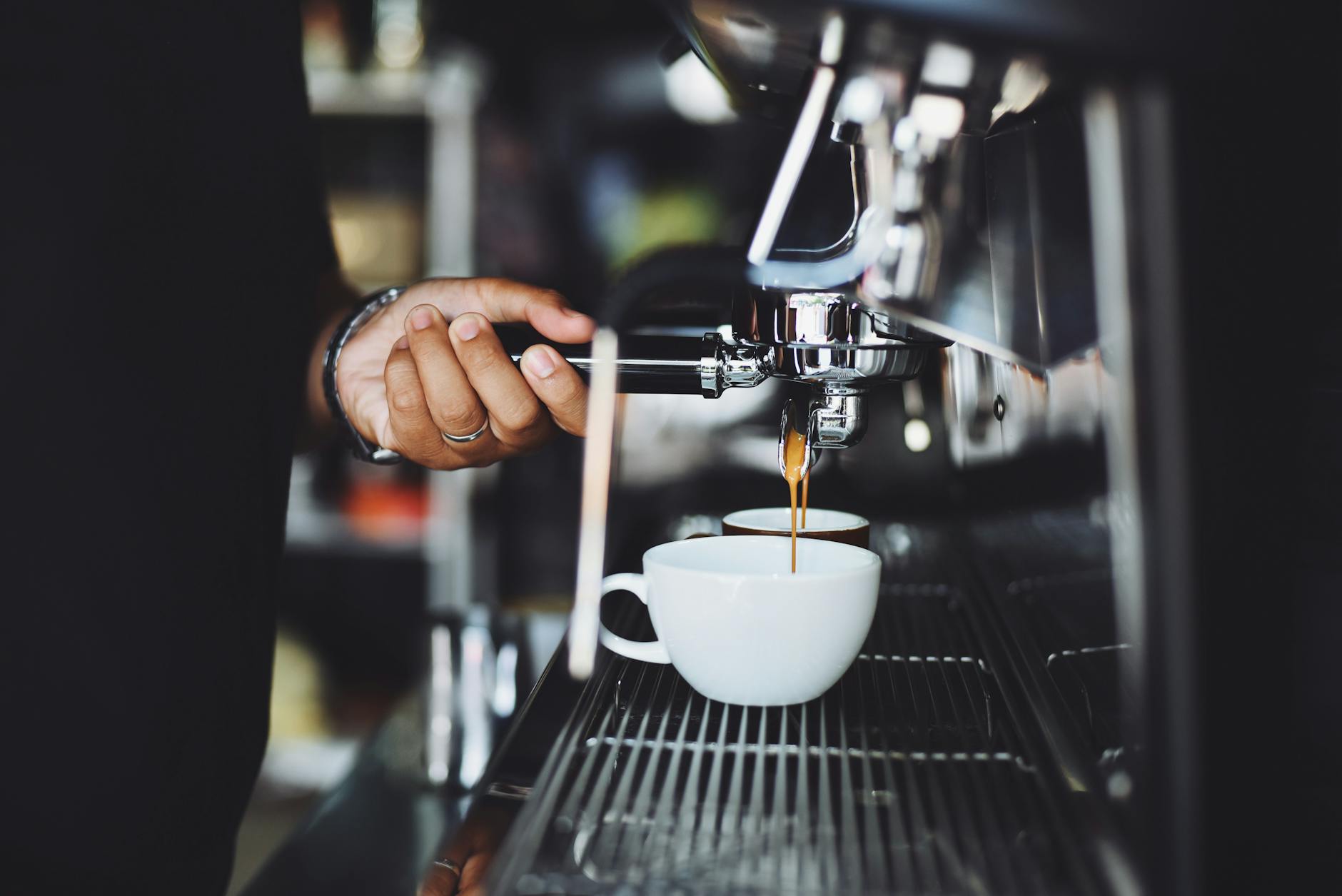

Do you dream of creamy cappuccinos and perfectly frothed lattes without leaving your house? Choosing a coffee machine with a milk frother is no easy task, given the dozens of models available. Between automatic systems, steam nozzles and milk jugs, it’s easy to get lost.
In this guide, we’ve tested and analysed the best machines on the market to help you make the right choice according to your budget, your consumption habits and your level of expertise. Discover our detailed comparison table and our expert recommendations to find the machine that will turn your kitchen into a real coffee shop.

☕ Summarize this article with AI
Comparison table: the best coffee machines with milk frother
| Model | Prices | Type of mousseur | Number of drinks | Highlights | Who is it for? |
|---|---|---|---|---|---|
| Philips 3300 LatteGo | 430€ | Automatic carafe | 5 dairy drinks | Excellent value for money, easy to clean | Beginners and small budgets |
| De’Longhi Magnifica Evo Next | 665€ | Automatic carafe | 13 drinks | Silent aerator, adjustable nozzle | Daily family use |
| Philips 5500 LatteGo | 1 100€ | Automatic carafe | 20 drinks | Eco mode, 4 user profiles, SilentBrew technology | Families and small businesses |
| De’Longhi Eletta Explore | 1 000€ | Dual hot/cold aerator | 24 drinks | Cold drinks, hot and cold frother | Iced coffee lovers |
| De’Longhi PrimaDonna Soul | 1 200€ | LatteCrema system | 18 drinks | Bean Adapt technology, large capacity | Discerning connoisseurs |
| Sage Bambino Plus | 330€ | Automatic steam nozzle | Manuel | Automatic milk frothing, compact | Amateur baristas |
Prices quoted in October 2025 – may vary according to promotions
Understanding the different types of milk frothers
Before choosing your machine, it’s essential to understand the differences between foaming systems. Each technology has its own advantages and corresponds to a specific user profile.
The manual steam nozzle
The steam nozzle is the most traditional system. You manually position a jug of milk under the nozzle, which diffuses steam to heat and froth the milk.
Advantages :
- Total control over foam texture and temperature
- Ideal for latte art
- Quick and easy to clean
- Thicker, creamier foam
Disadvantages :
- Requires time to learn
- Requires practice to obtain perfect foam
- Constant monitoring during preparation
- Longer preparation time
Our verdict: the steam nozzle is ideal for enthusiasts who like to be in control of their preparation and who are prepared to invest time in perfecting their technique. It’s the tool for budding baristas.
Automatic milk jug (One Touch system)
Automatic carafes such as the LatteGo from Philips or the LatteCrema from De’Longhi allow you to prepare milk drinks at the click of a button. The milk is drawn up, emulsified and poured automatically into the cup.
Advantages :
- Extremely easy to use
- Consistent foam every time
- Quick to prepare
- Easy to clean (often dishwasher safe)
- No skills required
Disadvantages :
- Little scope for customisation
- Standardised foam (fine texture)
- Higher prices
- Additional space
Our verdict: automatic carafes are perfect for those who regularly drink milk-based beverages and are above all looking for simplicity. They’re the number one choice for families and users in a hurry.
Cappuccinatore (flexible hose + aerator)
Some machines have a flexible hose that collects the milk from an external container (milk carton or dedicated carafe) and brings it to the nozzle where it is frothed.
Advantages :
- Semi-automatic preparation
- Moderate cost
- Correct efficiency
Disadvantages :
- Less convenient to clean than carafes
- Poor aesthetics (visible flex)
- Not fully automatic
Our verdict: it’s a good compromise between manual control and automation, but modern automatic decanters offer a better overall experience.
Our detailed selection of the best machines
Philips 3300 LatteGo: the best value for money
The Philips 3300 LatteGo is our favourite for users who are new to the world of automatic machines or who are looking for an affordable solution without compromising on quality.
Technical specifications :
- Ceramic grinder adjustable to 12 levels
- 1.8 litre water tank
- 275-gram grain bin
- 260 ml LatteGo milk jug
- 5 customisable drinks: espresso, coffee, iced coffee, cappuccino, latte macchiato
- AquaClean anti-scale filter
- 3 levels of intensity, length and foam
Our experience: In our tests, preparing a 127 ml cappuccino took 1 minute and 33 seconds with the default settings. Grinding is particularly discreet at 67dB, which is appreciable in the morning. On the other hand, the frother remains noisy at 82 dB during operation.
The LatteGo carafe is remarkably easy to clean: it has just 2 parts, with no hidden tubes. All it takes is a quick rinse under running water or a trip to the dishwasher.
Points of attention :
- The spout is not adjustable, which can be a problem with some cups
- The carafe cannot be used to prepare milk foam on its own.
- Preparation time is slightly longer than average
Guide price: €430
The verdict: an excellent choice for those who want quality cappuccinos without breaking the bank. The ultra-simple cleaning of the LatteGo carafe more than makes up for any minor drawbacks.
De’Longhi Magnifica Evo Next: the family choice
The Magnifica Evo Next is distinguished by its milk frother, which is considerably quieter than the competition – a major advantage for families.
Technical specifications :
- 1.8 litre water tank
- 250 gram grain bin
- 280 ml milk frother with adjustable nozzle
- 13 drinks available (including hot water)
- 4 length levels and 5 intensity levels
- 3 user profiles
- Responsive colour touchscreen
Our experience: The big plus point of this machine is the noise level of its milk frother, which oscillates between just 58 and 64 dB. This is exceptional, as most frothers exceed 80 dB. Grinding is in the middle of the range at 69dB.
The frothing nozzle is adjustable in height and angle, so it can be adapted to different cup shapes and sizes. A 140 ml cappuccino took 1 minute and 25 seconds in our tests.
Points of attention :
- Few dishwasher-safe components
- The double cup function is only available for espresso
- The drinks are generous, which slightly increases preparation time
Guide price: €665
The verdict: ideal for households where several people drink coffee throughout the day. The silent frother really makes a difference in everyday use.
Philips 5500 LatteGo: the top-of-the-range family machine
If you’re looking for a versatile machine with maximum customisation, the Philips 5500 LatteGo is a top choice.
Technical specifications :
- 20 different drinks, including 9 dairy drinks
- 5 intensities, 12 grinding levels, 3 temperature levels
- 4 user profiles + 1 guest profile
- SilentBrew technology (40% quieter)
- QuickStart function for rapid start-up
- Eco mode with water-saving rinses
- 260 ml LatteGo carafe
Our experience: This machine excels in energy management. The Eco mode reduces water consumption during rinses, the sleep mode is activated quickly, and the screen and indicator lights are dimmed. Shredding at 66dB makes it one of the quietest machines we’ve tested.
A 98 ml cappuccino is ready in 1 minute and 10 seconds. The ability to save 4 user profiles is particularly practical for families or small businesses.
Points of attention :
- The pouring spout on the carafe is fixed
- The aerator remains noisy at 83 dB on start-up
- Percolator maintenance can be tricky
Guide price: €1,100
The verdict: a substantial investment, but one that is justified for families or small businesses that entertain regularly. The variety of drinks and the Eco function are major advantages.
De’Longhi Eletta Explore: for iced coffee lovers
The Eletta Explore stands out with its two separate milk frothers for preparing hot and cold drinks.
Technical specifications :
- 24 drinks available
- 2 milk frothers (hot and cold)
- LatteCrema Hot and Cool system
- 3.5″ TFT touch screen
- Height-adjustable and tiltable aerator nozzle
- Ice cube tray included
- Weighs 11.2 kg
Our experience: The dual frothing technology is impressive. The hot milk frother works in the classic way, while the cold milk frother creates really great iced drinks. The display even indicates the number of ice cubes to add for each recipe.
Grinding is discreet at 65 dB and the quality of the espresso is excellent. A 150 ml cappuccino is prepared in 1 minute and 24 seconds.
Points of attention :
- The smartphone application is of little use and difficult to connect
- Pre-rinse uses 68 ml of water, which slightly dilutes the coffee
- Descaling takes about 15 minutes
Guide price: €1,000
The verdict: if you like to vary your pleasures and are interested in cold drinks, this is the machine for you. The double frothing system justifies its price.
Sage Bambino Plus: the best choice with steam nozzle
For those who prefer manual control without the complexity, the Sage Bambino Plus is an ideal manual espresso machine.
Technical specifications :
- Manual espresso machine
- Automatic milk frother with 3 settings
- Rapid heating
- Compact design
- High-performance steam nozzle
Our experience: The Bambino Plus offers an excellent compromise: you retain control over your espresso extraction, but the milk frothing is automated with three temperature and texture settings. Perfect for getting started with a manual machine without making life too complicated.
Guide price: €330
Verdict: an excellent choice for fans of manual machines who want simplified milk frothing. The price is very competitive.
How do I choose a coffee machine with milk frother?
Depending on how often you drink
Occasional consumption (1-2 milky coffees per week): Opt for a machine with a manual steam nozzle. The Sage Bambino Plus is ideal for this.
Regular consumption (1-2 milky coffees a day): Choose a One Touch system with an automatic carafe like the Philips 3300 LatteGo. It saves time and makes everyday life easier.
Intensive use (several coffees a day, family): Turn to top-of-the-range models like the Philips 5500 LatteGo or the De’Longhi Magnifica Evo Next, with large capacities and several user profiles.
Depending on your budget
Under €500: The Philips 3300 LatteGo (€430) or the Sage Bambino Plus (€330) offer the best value for money.
Between €500 and €800: The De’Longhi Magnifica Evo Next (€665) is an excellent investment for everyday family use.
Over €1,000: The Philips 5500 LatteGo (€1,100) and De’Longhi Eletta Explore (€1,000) are top-of-the-range machines that are justified for intensive or professional use.
Depending on your level of expertise
Beginners: Choose One Touch systems with automatic decanters. They require no special skills and produce consistent results.
Intermediate: You can opt for machines with several levels of settings and advanced functions, such as the Magnifica Evo Next.
Expert/hobbyist barista: Machines with a manual steam nozzle will allow you to explore latte art and perfect your frothing techniques.
Essential criteria to check
The quality of the mousseur
The type of frother determines your everyday experience. Automatic carafes such as LatteGo or LatteCrema offer a homogenous froth and simplified cleaning. Steam nozzles require more practice but give you total control over the texture.
Noise level
Noise is often underestimated, but it can become a nuisance if you make coffee early in the morning. Choose machines with a grinder below 70 dB and, if possible, a silent frother like the one on the Magnifica Evo Next.
Ease of maintenance
Check that the parts that come into contact with the milk are removable and dishwasher-safe. Systems without hidden tubes, such as the LatteGo, are much more practical for everyday use. An AquaClean anti-limescale filter also reduces the frequency of descaling.
Tank capacities
A water tank of at least 1.5 litres and a bean container of at least 250 grams will ensure you don’t need to refill too often. For families, aim for 1.8 litres of water and 275 grams of beans.
Customisation options
User profiles are invaluable when it comes to memorising individual preferences. With settings for intensity, temperature and foam quantity, you can fine-tune your drinks to suit your tastes.
Plant milk: does it work?
The good news is that most automatic frothing machines work with plant-based milks. However, not all plant-based milks are created equal when it comes to foaming.
Milk that foams well:
- Barista” oat milk (specially formulated for foaming)
- Enriched soya milk
- Barista almond milk
Our advice:
- Always use plant-based milks enriched with protein
- Choose the “barista” versions specially designed for foaming.
- Keep the milk cold (between 4 and 6°C)
- Clean the milk circuit immediately after use
The mousse obtained with plant milk will generally be lighter and less stable than with whole cow’s milk, but the result is still very satisfactory with the right products.
Mistakes to avoid
Neglecting to maintain the milk circuit
This is the most common mistake. A poorly cleaned milk circuit can quickly develop bacteria and alter the taste of your drinks. Always clean the frother after each use and run a full cleaning cycle every week.
Choose by price only
A €400 machine that’s well suited to your needs will satisfy you more than a €1,200 model that’s too complex or badly used. Define your real needs before being seduced by features you’ll never use.
Underestimating the footprint
Machines with automatic carafes take up more space. Measure the space available in your kitchen and check the dimensions of the machine (height, width, depth), not forgetting the space needed to remove the water tank.
Forget the cost of maintenance
In addition to the purchase price, think about the consumables: descaling agent, AquaClean filters (around €15 each), cleaning products for the milk circuit. These costs can add up to €50 to €100 a year, depending on how often you use your machine.
Our final verdict
For the majority of users, the Philips 3300 LatteGo represents the best compromise between quality, price and convenience. At €430, it offers everything you need for quality cappuccinos, with easy cleaning and proven reliability.
If your budget allows, the De’Longhi Magnifica Evo Next (€665) fully justifies its extra cost thanks to its exceptionally quiet frother and 13 customisable drinks. It’s our choice for everyday family use.
For enthusiasts who want the very best, the Philips 5500 LatteGo (€1,100) offers unrivalled versatility with its 20 drinks and eco-friendly functions, while the De’Longhi Eletta Explore (€1,000) will delight those who enjoy both hot and iced drinks.
Finally, the Sage Bambino Plus (€330) remains our recommendation for purists who prefer to retain control over their extraction while benefiting from automated foaming.
Did you know? The art of coffee requires a good understanding of the ideal grind for each extraction method. If you’re just starting out and don’t yet own a grinder, find out how to grind your beans without one until you invest in the right equipment.