Descaling your Krups Nespresso machine is an essential step in guaranteeing the longevity of your appliance and preserving the quality of your coffee. This guide takes you step by step through this operation, with specific procedures for each Nespresso-compatible Krups model.

☕ Summarise this article with AI
Why descale your Krups Nespresso?
The impact of limescale on your capsule machine
Unlike automatic bean-to-cup machines, Krups Nespresso machines (Citiz, Pixie, Inissia, Essenza Mini) work with a high-pressure capsule perforation system. This technology makes descaling even more crucial for several reasons.
Consequences of limescale build-up on your Nespresso
Limescale accumulates mainly in three critical areas of your machine:
- The thermoblock (rapid heating system) is less efficient, increasing the pre-heating time from 25 seconds to over 60 seconds.
- The 19-bar pump gradually loses pressure, reducing the quality of the crema
- The capsule perforator can become partially blocked, causing irregular flows.
Impact on your everyday coffee
In our experience with a number of ageing Krups Nespresso machines, the first signs of scaling are as follows:
- Coffee temperature reduced by 10 to 15°C (lukewarm instead of hot)
- Less abundant and less stable crema
- Unusual noises during extraction (vibrations, rattling)
- Slower flow: an espresso takes 40-50 seconds instead of 25-30 seconds
Cost of poor maintenance
Without regular descaling, you risk premature failure of the pump (replacement: €60-80 parts + labour) or the thermoblock (€80-120). These repairs are generally not covered by the warranty, as they are considered to be maintenance faults.
Identify your Krups Nespresso model
Before you start, identify your model precisely so that you can follow the correct procedure. The model number can be found on the label on the underside or rear of the machine.
Nespresso Original Line (Krups)
Compact models (most common)
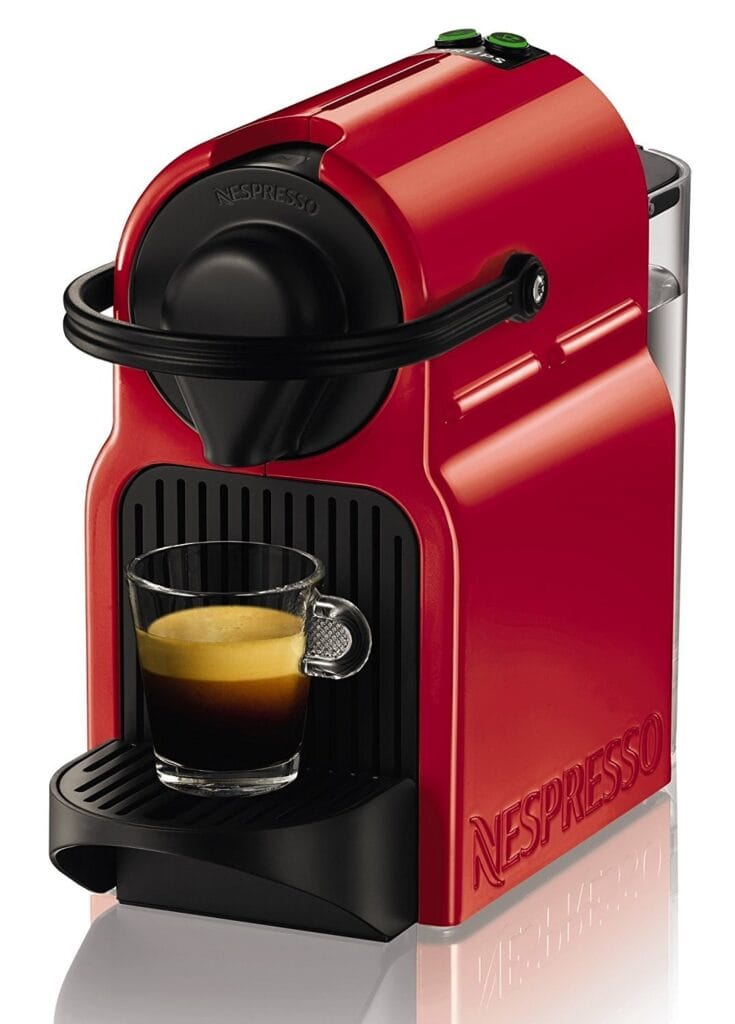
- Inissia (XN1005, XN1001): 2 buttons, 0.7L tank, best-selling model
- Essenza Mini (XN1108, XN110): ultra-compact, 2 buttons, 0.6L tank
- Pixie (XN3005, XN304): aluminium casing, 0.7L fuel tank, premium design
Models with extended tank
- Citiz (XN7405, XN741): 1L tank, 2 buttons, urban design
- Citiz & Milk (XN760, XN761): version with Aeroccino frother included
Top-of-the-range models
- Expert (XN6008): touch screen, Bluetooth connectivity
- Workshop (XN8908): integrated milk foam system
Important: This guide only applies to Nespresso machines with capsules manufactured by Krups. If you have a Krups bean-to-cup machine (Evidence, Essential, Arabica ranges), please consult our descaling guide for Krups bean-to-cup machines.
Recommended descaling frequency
The frequency depends on two main factors: the hardness of your water and your daily consumption.
Depending on water hardness
| Water hardness | Indicator | Frequency of descaling | Number of capsules |
|---|---|---|---|
| Very mild (0-7°f) | Few white marks on taps | Every 6 months | ~600 capsules |
| Mild (8-15°f) | Some light deposits | Every 4 months | ~400 capsules |
| Hard (16-25°f) | Regular visible traces | Every 3 months | ~300 capsules |
| Very hard (>25°f) | Large and rapid deposits | Every 2 months | ~200 capsules |
Hardness test: Use the test strips supplied with your machine (if present in the original packaging) or contact your local water distributor to find out the hardness in your area.
Depending on your consumption
- Intensive use (4-6 capsules/day): descaling every 2-3 months
- Moderate use (2-3 capsules/day): descaling every 3-4 months
- Occasional use (<2 capsules/day): descaling every 4-6 months
Our advice from experience: programme a recurring alert on your telephone every 3 months. This frequency is suitable for most situations and effectively prevents severe scaling.
Descaling solutions: full comparison
Official Nespresso descaling kit (recommended)
Benefits
- Specific formulation tested on Nespresso machines
- Pre-measured dosage (no error possible)
- Preserves the manufacturer’s warranty
- No residual odour after rinsing
- Price: around €10-12 for 2 scaling operations
Disadvantages
- More expensive than alternatives
- Limited availability (Nespresso boutiques, official website)
Our experience: after testing different solutions, the official kit remains the most effective. Descaling is quicker (fewer rinsing cycles required) and the odour disappears immediately.
White vinegar: use with care
The truth about white vinegar
The debate is raging on the forums: can white vinegar be used to descale a Krups Nespresso? Here’s our nuanced position after several years of use.
Real benefits
- Very economical (less than €1 per descaling)
- Effective on limestone
- Ecological and available everywhere
Documented risks
- Persistent odour difficult to eliminate (requires a minimum of 4-5 rinse cycles)
- Residual taste may affect the first 2-3 coffees
- Potential damage to rubber seals (observed after 3-4 years of intensive use with vinegar)
- May invalidate warranty under terms and conditions
Secure protocol if you use it
- Imperative dosage: 1/3 white vinegar + 2/3 water (never more concentrated)
- Limited contact time: maximum 30 minutes on the circuit
- Intensive rinse: minimum 3 complete cycles with clear water
- Reduced frequency: space out vinegar descaling (alternation with official product recommended)
Our honest recommendation: white vinegar works, but requires more work (multiple rinses) and carries long-term risks. For a new machine under warranty, use the official descaler. For a machine over 3 years old, vinegar is still an acceptable option, provided you follow the above protocol.
Citric acid: the right compromise
The best value for money in our opinion
- Dosage: 10-15g citric acid powder for 500ml water
- Natural, with no lingering odour
- Efficient and respectful of components
- Moderate price: €2-3 per descaling
- Available in supermarkets and pharmacies
Citric acid represents the best compromise between effectiveness, cost and respect for the machine. We use it regularly with no negative effect on the seals.
Universal descaling procedure (all Krups Nespresso models)
This procedure works on all Nespresso models manufactured by Krups (Inissia, Pixie, Citiz, Essenza Mini, Expert). Only the activation of the descaling mode varies slightly from model to model.
Preparation time (5 minutes)
Materials required
- 1 Nespresso descaling kit or alternative solution (vinegar/citric acid)
- 1 container of at least 1 litre
- Clear water for rinsing (approx. 1.5L)
Preparatory stages
- Switch on the machine and wait for the lights to stop flashing
- Eject the capsule if there is one in the chamber
- Empty the used capsule tray completely
- Empty and clean the drip tray
- Remove the water tank and empty it completely
Preparing the descaling solution
With official Nespresso kit
- Pour the contents of a sachet into the empty tank
- Make up to the “max” mark with 500ml of water
- Mix lightly by shaking the tank
With white vinegar
- Pour in 170ml white vinegar (1/3 of the tank)
- Top up with 330ml of clear water (2/3 of the tank)
With citric acid
- Dissolve 10-15g of citric acid powder in 500ml of lukewarm water
- Mix until completely dissolved
Activate descaling mode depending on your model
Inissia, Pixie, Essenza Mini, Citiz models (standard procedure)
- Replace the reservoir filled with descaling solution
- Place the empty container (minimum 1L) under the coffee outlet nozzle
- Activating the mode: Simultaneously press the 2 buttons (small and large cup) for 3 seconds until they flash rapidly.
- The buttons are now flashing rapidly: descaling mode is activated
Expert model (with touch screen)
- Switch on the machine
- Press the “Settings” icon (cogwheel)
- Select “Descale” from the menu
- Follow the instructions on the screen
Workshop model
- Access the “Maintenance” menu via the touch screen
- Select “Descaling
- Confirm the launch
Descaling cycle (15 minutes)
Phase 1: Descaling
- Press the “large cup” (or “lungo”) button to start the cycle
- The descaling solution flows into the container (takes about 5-7 minutes)
- Wait until the tank is completely empty
- Important: Do not empty the container! You are going to reuse this solution
Phase 2: Second pass
- Pour the contents of the container into the tank (recovery of the used solution)
- Replace the tank and the empty container
- Press “large cup” again to restart a cycle
- This second pass improves the effectiveness of descaling
Why two passes? The first pass dissolves the limescale, the second rinses it off and removes the loose residue. This method doubles the effectiveness without wasting product.
Rinse (10 minutes)
Critical phase often neglected
- Remove the tank, empty it completely and rinse it thoroughly with clean water.
- Fill it with fresh water up to the “max” mark
- Replace the tank and empty container under the nozzle
- Press “large cup” to start the complete rinse
- Additional rinsing: Repeat the operation a second time (strongly recommended, compulsory if you have used white vinegar).
Our advice from experience: after descaling, systematically discard the first 2 capsules of the following day. The residual taste can persist in the first coffee even after a good rinse.
Exit descaling mode
Standard procedure (Inissia, Pixie, Citiz, Essenza Mini)
- Press the 2 buttons simultaneously for 3 seconds
- The buttons stop flashing: the machine has returned to normal mode
- Allow the machine to warm up (indicator lights steady)
- Your Krups Nespresso is ready!
Models with display: descaling mode exits automatically at the end of the process.
Troubleshooting
Lights that stay on after descaling
Common problem: The indicator lights continue to flash even after the machine has been fully descaled.
Causes identified
- Decalcifying cycle interrupted before completion
- Decalcifying mode not exited correctly
- Water level sensor incorrectly positioned
Step-by-step solutions
- Simple reset: Unplug the machine for 30 seconds, then plug it back in.
- Checking accessories: Make sure all trays are correctly positioned (audible locking click)
- New exit cycle: Press the 2 buttons simultaneously for 5 seconds.
- Last resort: Restart a complete descaling cycle from the beginning
If the problem persists: The scale sensor may be faulty. Contact Krups after-sales service on 09 74 50 10 61.
Machine blocked in descaling mode
Symptoms
- Continuously flashing lights
- Unable to make coffee
- No reaction to pimples
Emergency solution
- Forced exit: Hold down the 2 buttons simultaneously for 10 seconds (not 3).
- If unsuccessful: Unplug the machine, wait a full 2 minutes, then plug it back in.
- Complete reset: Unplug the appliance, remove the reservoir + capsule container + drip tray simultaneously, wait 30 seconds, plug back in and replace all the components in the correct order.
Prevention: Never switch off or unplug the machine during a descaling cycle. Always allow the process to finish completely.
Ineffective descaling (persistent problem)
Diagnosis
- Flow always slows down after descaling
- Coffee always lukewarm
- Persistent abnormal noises
Enhanced solutions
- Double descaling: Repeat the operation immediately with a fresh solution (this time, do not reuse the solution from the first run).
- Extended soak: Fill the tank with descaling solution, leave for 1 hour without running, then start the normal cycle.
- Manual descaling of the nozzle: Remove the outlet nozzle (if your model allows), soak it for 30 minutes in pure white vinegar and rinse thoroughly.
- Checking the perforator: Open the lever, visually check the perforating needle and gently clean it with a fine needle if any scale is visible.
Extreme case: If your machine has not been descaled for several years, the limescale may be too ingrained for domestic descaling. In this case, only professional descaling (after-sales service) can save the machine.
Problems after descaling with vinegar
Persistent taste and odour
If you have used white vinegar and the smell or taste persists after 3 rinsing cycles:
- Intensive rinse: Run 2 extra cycles in clean water
- Neutralising with bicarbonate of soda: Dissolve 1 teaspoon of bicarbonate of soda in 500ml of water, run through 1 cycle, then rinse 2 times with clean water.
- Patience: The smell will disappear completely after 5-10 capsules.
Leaks after descaling with vinegar
The vinegar may have damaged a seal. In this case :
- Stop using immediately
- Contact the after-sales service (caution: the use of vinegar may not be covered by the warranty)
- Specify that you have used diluted vinegar (important transparency)
Preventive maintenance between descaling
Daily gestures
After each use
- Always eject the used capsule (never leave a capsule in the chamber).
- Empty the capsule tray as soon as it contains 5-6 capsules
- Wipe the outlet nozzle with a damp cloth
Weekly
- Clean drip tray thoroughly with hot soapy water
- Rinsing the water tank (empty completely, rinse, refill with fresh water)
- Wipe the outside of the machine with a soft cloth
Optimising water quality
Filter cartridge: really useful?
Krups Nespresso machines do not generally have a built-in filtration system (unlike bean-to-cup machines). However, you can improve the quality of the water you use.
Efficient solutions
- Carafe filter (Brita type): reduces limescale by 50-70%, extends descaling intervals by a further 2 to 3 months
- Low mineral content bottled water: ideal dry residue between 150-300 mg/L (examples: Volvic, Mont Roucous)
- Avoid: very hard tap water, demineralised water (spoils the taste), sparkling water
Cost vs. benefit: A carafe filter costs around €25 + €15/month for cartridges. If you drink 3-4 coffees a day, this will significantly extend the life of your machine and improve the taste. The investment will pay for itself on a new machine costing €100-150.
Early detection of problems
Warning signs to watch out for
If you notice any of these signs, early descaling is recommended:
- Longer warm-up time (>40 seconds instead of 25)
- Coffee that flows in a trickle instead of a steady stream
- Unusual noises (rattling, vibrations) during extraction
- No or very thin crema
- Whitish marks visible on the outlet nozzle
Recommended maintenance booklet
Write it down in a notebook or smartphone note:
- Date of each descaling
- Product used
- Number of capsules since last descaling (approximate)
- Any problems encountered
This traceability will help you to optimise frequency and detect any recurring problems.
Specifications by Nespresso Krups model
Nespresso Inissia Krups
Features
- Reservoir: 0.7L (approx. 6-9 coffees)
- Capsule bin: 11 used capsules
- Total descaling time: 20-25 minutes
Special feature: The Inissia is the simplest model. The water tank can be difficult to remove on some versions. Tip: tilt the machine slightly backwards and pull the tank upwards.
Nespresso Pixie Krups
Features
- Fuel tank: 0.7L
- Capsule bin: 10 used capsules
- Aluminium casing (more durable)
Special feature: The Pixie has a fibre-optic water level indicator (small light point on the side). Make sure this light is working properly before descaling. If it is faulty, check the level manually during the cycles.
Nespresso Citiz Krups
Features
- Fuel tank: 1L (the largest in the range)
- Capsule bin: 10 used capsules
- Available with Aeroccino aerator
Special feature: The large reservoir requires more descaling solution (600-700ml instead of 500ml for optimal descaling). If you have the “& Milk” version, only descale the machine, the Aeroccino frother can be cleaned separately (no descaling necessary, just rinsing).
Nespresso Essenza Mini Krups
Features
- Fuel tank: 0.6L (smallest)
- Ultra-compact (11cm wide)
- Capsule container: 6 used capsules
Special feature: Because of the small reservoir, you will need to refill it twice during the rinsing process. The small capsule container needs to be emptied more frequently on a daily basis.
Nespresso Expert Krups
Features
- Touch screen
- Bluetooth connectivity
- Customisable coffee profiles
Special feature: Descaling is initiated via the “Settings” menu on the touch screen. The machine guides you through the process visually, step by step. Advantage: it’s impossible to make a mistake. Disadvantage: if the screen is faulty, descaling becomes impossible (after-sales service required).
Frequently asked questions
Can I descale with bleach or household products?
No, absolutely not! Bleach or any other chlorinated household product is toxic and dangerous. Only specific coffee machine descalers, food-grade citric acid or white vinegar are acceptable. The use of unsuitable products will immediately invalidate the warranty and may render the machine dangerous.
Is it necessary to descale a new machine?
No, a new machine does not need initial descaling. Descale for the first time after 200-300 capsules or 2-3 months of use, depending on your consumption. This initial operation establishes a clean base for future maintenance.
Can I use the descaling capsules?
Beware of confusion: there are no descaling capsules for Nespresso. Some brands offer “cleaning capsules” that clean coffee residue but do not descale. Descaling requires a liquid that circulates throughout the system.
My machine leaks after descaling. Is this normal?
No, this is not normal. A leak after descaling indicates :
- A damaged seal (possibly caused by an aggressive product)
- A plug of displaced limestone creates excess pressure
- A pre-existing problem revealed by scaling
In all cases: stop use and contact the after-sales service. The leak could get worse and cause a short-circuit.
How long does a full descaling procedure take?
Allow 30 minutes from A to Z:
- Preparation time: 5 minutes
- Descaling cycle: 15 minutes
- Rinse: 10 minutes
Plan this time in advance, as the process cannot be interrupted once it has started.
Does descaling cancel my warranty?
On the contrary! Regular descaling is mandatory to maintain the warranty. The Nespresso and Krups general conditions stipulate that maintenance must be carried out as recommended. On the other hand, the use of non-recommended products (vinegar, household products) may pose a problem in the event of a warranty claim.
Can I drink the descaling water by mistake?
Descalers for coffee machines are not toxic if accidentally ingested in small quantities (insufficient rinsing), but they are irritating. If you notice an abnormal taste, discard the coffee and carry out 2-3 additional rinsing cycles. If you swallow a large amount of concentrated descaling solution: contact a poison control centre.
What should I do if I’ve forgotten to descale for 2 years?
If your machine is still working after 2 years without descaling, try a reinforced descaling :
- Double descaling with concentrated solution
- Extended soaking (2 hours)
- Intensive rinse
If that doesn’t do the trick, the limescale is probably too ingrained. Only professional descaling (after-sales service) can save the machine. Lesson to remember: preventive maintenance costs €10 every 3 months, while repairs cost €80-120.
Recommended maintenance accessories
To optimise the life of your Krups Nespresso, we recommend that you equip it with a few essential accessories. Take a look at our selection ofprofessional coffee accessories that will perfectly complement your installation.
If you’d like to make coffee with freshly ground beans for a more varied experience, read our guide to grinding coffee beans without a grinder.
To perfect your filter coffee preparations to complement your Nespresso, consult our guide to the perfect doses for a 4-cup filter coffee.
When to contact Krups after-sales service
Warning signs requiring professional intervention
Contact the After-Sales Service if you notice :
- Descaling impossible to complete after several attempts
- Major leaks that persist after descaling
- Error lights that never go out despite resets
- Persistent abnormal noises (metal creaking, loud banging)
- Machine overheating (housing very hot to the touch)
- Short circuit or burning smell
Information to prepare before calling
To speed up your treatment:
- Exact model and reference (label under the machine)
- Date of purchase and serial number
- Precise description of symptoms
- Maintenance history (frequency of descaling, products used)
- Purchase invoice (if under warranty)
Krups after-sales contact: 09 74 50 10 61 (Monday to Friday, 9am-6pm)
Conclusion: maintenance, a guarantee of longevity
Regular descaling of your Krups Nespresso machine is not an option but a necessity. This simple 30-minute operation every 3 months guarantees :
- Consistent coffee quality (temperature, crema, flavours)
- An extended lifespan of 3-5 years on average
- Substantial savings (prevention of costly breakdowns)
- Compliance with the manufacturer’s warranty
Our final tip: Programme a recurring alert every 3 months on your smartphone with the title “Descale Nespresso”. This simple habit will prevent you from forgetting and breaking down prematurely.
Preventive descaling costs €10 and takes 30 minutes. A pump repair costs €80 and deprives you of coffee for several days. The choice is quickly made!