
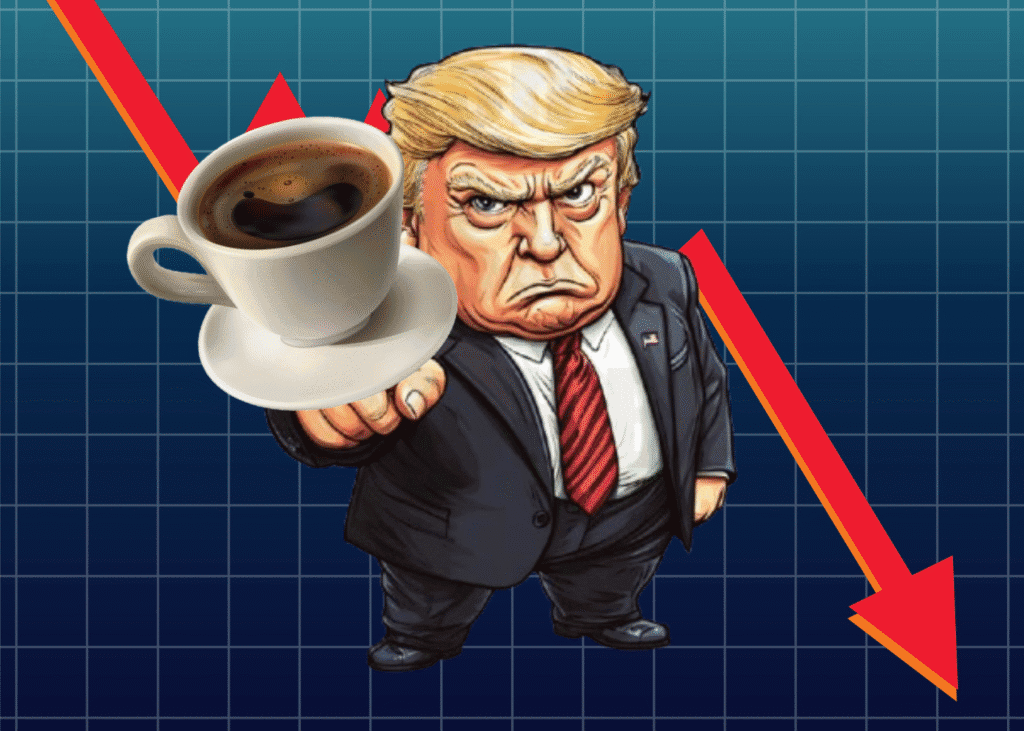
Your $6 morning coffee just became a political football. After Trump’s tariffs sent coffee prices soaring 40% this year, forcing you to choose between your daily caffeine fix and paying rent, the president suddenly reversed course. On November 14, he scrapped the coffee tariffs that he himself created.
But here’s what they’re not telling you: Your coffee won’t get cheaper anytime soon. In fact, most Americans will keep overpaying for months. Here’s why—and what you can actually do about it.

☕ Summarise this article with AI
What Trump Actually Did
The president eliminated 40-50% tariffs imposed in April 2025 on coffee imports, primarily from Brazil, which supplies roughly one-third of U.S. coffee. These tariffs had driven coffee prices up 19% year-over-year, reaching a record high of $8.41 per pound in July 2025.
The executive order specifically states that certain agricultural products “cannot be grown, mined, or naturally produced in the United States in sufficient quantities” and therefore should not be subject to reciprocal tariffs.
Countries affected:
- Brazil (removed November 20)
- Vietnam
- Colombia
- Ecuador
- Guatemala
- El Salvador
The tariff exemptions are backdated to November 13, meaning importers may be eligible for refunds on duties paid since that date.
Why Trump Changed Course
Trump faced mounting political pressure after voters in off-year elections earlier in November cited economic concerns as their top issue, resulting in Democratic victories in Virginia and New Jersey.
The Perfect Storm for Coffee Prices
Three factors created record-high coffee prices in 2025:
- Trump’s tariffs (40-50% on imports)
- Catastrophic weather in Brazil (worst drought in 70 years) and Vietnam
- Financial speculation on commodity markets
According to Bureau of Labor Statistics data, roasted coffee prices climbed 18.9% year-over-year in September, the largest jump since the 1990s.
The Dirty Secret They Don’t Want You to Know
You’re Still Paying Trump’s Inflated Prices
Think you’ll save money next week? Think again. Here’s the timeline grocery stores are hiding from you:
Week 1-2 (Now): Nothing changes. Stores keep selling overpriced inventory
Week 3-4: Still nothing. Roasters process tariff-free beans slowly
Month 2-3: Maybe—if your store feels generous—you see tiny drops
Month 3-4: Finally, actual relief arrives (if you’re lucky)
Translation: Stores will pocket the savings while you keep overpaying for at least 8-12 weeks.
Why? Because Walmart, Costco, and Target have zero incentive to lower prices fast. They bought inventory at inflated costs and want to recoup every penny before passing savings to you.
How Much Will Prices Drop?
Analysts estimate coffee prices could fall 10-15% from current levels, but they’ll remain 15-20% higher than pre-tariff 2024 prices due to:
- Weather-related supply constraints
- Increased global demand (especially from China)
- Elevated production costs
Trump’s Coffee U-Turn: Admitting He Was Wrong All Along
Let’s be crystal clear: Trump created this mess, then pretended to fix it.
In April 2025, he slapped 50% tariffs on Brazilian coffee—which supplies a third of U.S. imports—claiming it would “protect American interests.” Spoiler alert: America grows virtually zero coffee.
The result? Coffee prices exploded 40% in six months, hitting $8.41/lb in July—a record high. Your $4 latte became $6. Your grocery bill jumped $200/year just for coffee.
Democrats immediately pounced. Rep. Don Beyer (D-VA) didn’t mince words: “President Trump is finally admitting what we always knew: his tariffs are raising prices for the American people.”
Why Trump Actually Reversed Course
Not because he cares about your wallet. Because voters punished Republicans in November elections:
- Democrats won Virginia by 8 points
- New Jersey flipped blue
- Voters ranked “cost of living” as issue #1
Trump’s approval rating crashed to its lowest point since returning to power. The coffee tariff became the poster child for his failed economic policy.
On Air Force One, Trump finally admitted tariffs “may, in some cases” raise prices—after seven months of denying it.
What Coffee Industry Insiders Are Saying
Roasters and Café Owners
Coffee roasters and café operators had warned for months about the tariff impact. Since the U.S. produces virtually no coffee domestically, importers had no alternative suppliers to avoid the duties.
Many cafés added surcharges of 18-25% to menu prices or reduced cup sizes to maintain margins. With tariffs removed, these operators face difficult decisions about whether to lower prices or preserve improved margins.
Grocery Retailers
The Food Industry Association applauded the move, noting import taxes “are an important factor” in supply chain complexity. Major retailers including Kroger, Safeway, and Albertsons had increased coffee shelf prices by 12-19% since April.
Global Coffee Market Context
Record Prices in 2025
Global coffee futures hit a 50-year high in February 2025, driven by:
- Brazil’s production down 18% due to drought
- Vietnam’s robusta shortage
- Ethiopian export challenges
- Rising demand in China (+40% over 5 years)
Modest Price Relief in November
Coffee futures have moderated slightly: $405.81/lb on November 20, down 1.87% for the month but still +37.58% year-over-year.
The International Coffee Organization (ICO) October 2025 report showed the composite indicator price averaging $3.26 per pound, a modest 0.5% increase from September.
Looking Ahead to 2026
Lavazza CEO Giuseppe Lavazza predicts 2026 will be “calmer” with “less volatile” coffee prices, based on:
- Improved Brazilian harvest projections
- Vietnam production rebounding 6.9% to 31 million bags
- Reconstituted port inventories in Europe and North America
However, USDA forecasts show arabica production declining 1.7% while robusta rises 7.9%, potentially creating quality-price tensions.
Stop Waiting for Prices to Drop—Do This Instead
Forget hoping stores will play fair. Here’s how to slash your coffee costs by 50% starting today:
1. Ditch Pre-Ground Coffee Immediately
Pre-ground coffee is a scam. It loses 60% of flavor in two weeks and costs 30% more per cup. Buy a $35 burr grinder from Amazon and whole beans. You’ll save $400/year minimum.
2. Cancel Your Starbucks Habit (Seriously)
At $6 per visit, 5 days/week = $1,560/year. Make cold brew concentrate at home for $0.20/cup. A $20 cold brew maker pays for itself in 10 days.
3. Lock In Prices NOW with Subscriptions
Trade Coffee, Atlas Coffee Club, and Blue Bottle lock rates for 6-12 months. Sign up this week before they adjust for 2026. Save 15-25% versus retail chaos.
4. Buy Brazilian Santos or Colombian Beans
These origins offer the best quality-to-price ratio. Skip Ethiopian and Kenyan beans—they’re 40% more expensive due to export bottlenecks. Same great coffee, half the cost.
5. Stock Up Smart (But Not Stupid)
Whole beans stay fresh for 3-4 months in an airtight container. Buy in bulk when you see sales. But don’t hoard—beans over 4 months old taste like cardboard.
What Happens Next?
Tariff Policy Uncertainty
Trump suggested on Air Force One that tariff revenue might fund $2,000 checks to Americans in 2026, though he remained vague on timing. He also mentioned using tariff revenue to pay down national debt, raising questions about budget priorities.
Trade Deal Impacts
The framework agreements with Ecuador, Guatemala, El Salvador, and Argentina include provisions to ease tariffs on agricultural products while opening markets for U.S. industrial exports.
The USDA is reassessing farmer aid programs given these new trade deals. Deputy Secretary Stephen Vaden indicated the agency would evaluate whether tariff-related farmer compensation remains necessary.
The Brutal Truth About Your Coffee Prices
Let’s cut through the BS:
✗ Trump’s tariff removal won’t help you for months
✗ Stores will keep charging inflated prices as long as possible
✗ Coffee will NEVER return to 2023 prices—that ship has sailed
✗ China’s exploding coffee demand means permanent price pressure
✓ But you CAN take control right now
✓ Switch to whole beans and home brewing = save $1,200/year
✓ Lock in subscription rates before 2026 increases hit
✓ Stop funding coffee shops’ 300% markups
What Happens Next?
Trump’s promising $2,000 checks from tariff revenue in 2026. Don’t hold your breath—he’s been vague on timing and also wants to use that money to pay down national debt. Classic bait-and-switch.
Meanwhile, Brazil’s 2026 harvest will determine if prices actually drop or just stabilize at “slightly less insane” levels.
The Bottom Line: Trump broke your coffee budget, “fixed” it with fanfare, but you’re still screwed for months. The only real solution? Stop relying on grocery stores and politicians to save you. Take matters into your own hands.
Your wallet will thank you.
Sources: NPR, CNBC, Bloomberg, CNN, CBS News, National Coffee Association, USDA | Fact-checked: November 21, 2025