
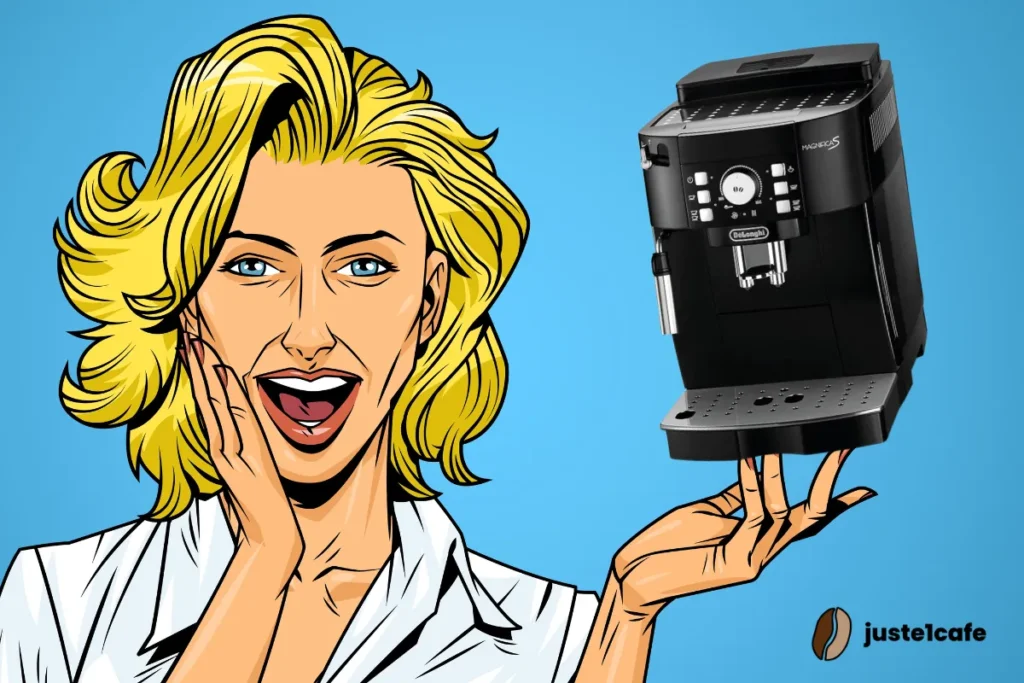
The DeLonghi Magnifica S (ECAM 22.110.B) has become a benchmark among coffee machines with a grinder. With prices regularly hovering around €280-300, it is one of the best-selling models in France. But beyond its commercial success, what about its performance? After three years of daily use and hundreds of cups prepared, I share my full feedback.

☕ Summarise this article with AI
Our verdict in brief
Highlights ✅
- Value for money hard to beat in its category
- Conical steel grinder with 13 adjustment positions
- Proven reliability over time (with rigorous maintenance)
- Easy maintenance thanks to removable percolator unit
- Relative compactness (23.8 × 43 × 35 cm)
Weak points ❌
- Plastic finish (although robust)
- Dated interface without screen
- Manual steam nozzle requires practice
- Fairly high noise level (70 dB during shredding)
- High water consumption during rinsing
Overall score: 4/5 – An excellent choice for getting started in the world of coffee beans, provided you accept a few compromises on user comfort.
Overview: what does the Magnifica S have to offer?
Key technical features
The Magnifica S is DeLonghi’s entry-level model, without cutting corners:
Extraction and pressure
- Pump pressure: 15 bar (market standard)
- Thermoblock system for stable temperature
- Temperature adjustable on 4 levels (up to 98°C maximum)
- Removable percolator unit for easy cleaning
Grinding
- Stainless steel conical mill
- 13 grind setting positions (actually 11 usable)
- Bean bin capacity: 250 g
- Possibility of using pre-ground coffee
Capacities and dimensions
- Water tank: 1.8 L
- Coffee grounds bin: capacity for 14 wafers
- Adjustable discharge height: 86-142 mm
- Dimensions: 23.8 × 43 × 35.1 cm
- Weight: 9 kg
Drinks and personalisation
- 2 direct-access recipes: espresso and lungo
- Simultaneous preparation of 2 cups
- Manual steam nozzle for dairy drinks
- Intensity adjustment via central knob
Design and ergonomics: simplicity above all
Functional design with no frills
The Magnifica S doesn’t try to impress visually. Its glossy black (or silver, depending on the version) plastic casing is a clear indication of its entry-level ambitions. Fingerprints quickly accumulate on the black version, a point that can irritate perfectionists.
But make no mistake: these plastics are of good quality. After three years of intensive use, my machine shows no cracks or signs of brittleness. The stainless steel drip tray adds a welcome touch of robustness.
Interface: effective but dated
The control panel with its physical buttons divides users. Personally, after 15 years of handling different machines, I appreciate this direct approach: one button for espresso, one for lungo, a knob for intensity. No complex menu, no fussy touch screen.
The downside? Advanced settings (temperature, water hardness, automatic shut-off) require unintuitive button combinations. Once you’ve mastered these settings, they become second nature. Once mastered, these settings become second nature, but the learning curve remains real.
Accessibility and daily maintenance
DeLonghi has made judicious choices when it comes to ergonomics:
Positive points
- Top-access water tank
- Percolator unit removable in 10 seconds (a luxury at this price)
- Easily removable grounds bin and drip tray
- Practical pre-ground coffee tray for decaffeinated coffee
Areas for improvement
- Transparent bean container: you can see the level, but the lid makes the water overflow if you fill it to the brim
- Small capacity grounds bin (14 cakes): to be emptied every 2-3 days for regular users
- No signal when the grain bin is empty (you can tell by the noise of the mill)
Coffee quality: where the Magnifica S really shines
Espresso: precise and balanced
This is where the machine really comes into its own. Unlike some competitors in the same price range (I tested the Philips 2200 and Krups EA8108), the Magnifica S excels at extracting a well-balanced espresso.
What I observed during my tests:
- The crema is generous and stable, a sign of optimal extraction under pressure
- The aromas of cocoa, chocolate and dried fruit come through particularly well
- The temperature in the mouth is perfect (neither hot nor warm)
- The consistency between cups is impressive
My expert advice: set the grinder between positions 2 and 4 for an authentic Italian espresso. Positions 1-2 run the risk of blocking the machine with certain very roasted beans.
Choosing the right grain
After testing around twenty different coffees on this machine, here are my observations:
- 70% arabica / 30% robusta blends: excellent results, abundant crema
- 100% arabica: also very good, with more subtle aromas
- Dark roasts: pay attention to the grinder setting (not too fine)
- Oily or caramelised grains: absolutely avoid, risk of premature clogging
Lungo: disappointing (as with all machines in this category)
Let’s be frank: the long coffee obtained via the lungo button is not up to scratch. The water passes too long through the grind, extracting bitter compounds that throw the cup off balance.
My solution: I always make an americano (espresso + hot water through the steam nozzle). The result is incomparably better, with all the richness of espresso diluted in hot water. This method takes 30 seconds longer, but it’s worth it.
Dairy drinks: using the steam nozzle takes some skill
The Magnifica S has a manual steam nozzle, a choice that may put off beginners. Personally, I see this as an advantage once I’ve mastered the technique.
First steps with the steam nozzle:
- The first 10 attempts will probably be disappointing (foam too liquid or too aerated).
- Use very cold whole milk (3-4°C) for best results
- Place the nozzle 1 cm below the surface, slightly off-centre
- Aim for a maximum of 60-65°C (the temperature at which you can no longer hold your hand against the carafe).
Once you’ve mastered the technique (allow 2-3 weeks of regular practice), you’ll be able to make perfectly respectable cappuccinos and latte macchiatos. The steam pressure is not as high as that of a professional machine, but it does create a creamy microfoam.
Practical tip: systematically clean the nozzle after each use (one blast of steam + wipe with a damp cloth). This 10-second routine will prevent dried milk plugs and a deterioration in foam quality.
Performance and preparation time
Speed: an undeniable strength
The Magnifica S is one of the fastest machines in its category:
Complete sequence of the first morning coffee:
- Power on: 10 seconds
- Pre-heating: 25-30 seconds
- Automatic rinse: 10 seconds (uses approximately 64 ml of water)
- Grinding + espresso extraction: 35-40 seconds
Total: approximately 1 minute 20 seconds from start-up to first cup served.
For the following cups, count on just 35-40 seconds (grinding time + extraction). This is one of the best times I’ve measured on machines in this price range.
Noise level: the main flaw
At 70-72dB, measured with a sound level meter during shredding, the Magnifica S is no mean feather in its cap. This noise level corresponds roughly to :
- A conversation in a normal voice
- A short-distance hoover
- A hairdryer in medium mode
In practice: if you make your coffee at 6am while others are sleeping in adjacent rooms, you’ll probably wake them up. Higher-end machines (such as the DeLonghi Dinamica or the Jura S8) incorporate soundproofing mechanisms that are absent from the Magnifica S.
The noise is due to the plastic construction, with no sound insulation, and the conical metal grinder, which comes into direct contact with the grain. This is the price we have to pay to keep our prices under €300.
Water and energy consumption
The Magnifica S presents an interesting paradox: it is energy-efficient but water-hungry.
Power consumption:
- Smart standby mode after 15 minutes (adjustable up to 3 hours)
- Thermoblock system that only heats the water you need (more economical than a traditional boiler)
- Power: 1450 W in operation
Water consumption:
- Automatic rinse on ignition: ~64 ml
- Automatic rinse on switch-off: ~64 ml
- For 4 espressos a day: approximately 200-250 ml of water for rinses + 100-120 ml for coffees = 320-370 ml/day
Admittedly, these automatic rinses consume more water than an espresso itself, but they contribute directly to the machine’s longevity by preventing the build-up of residue. After three years, I can confirm that this sacrifice of water is well worth it.
Maintenance: simple but regular
Daily maintenance (2-3 minutes)
What I always do:
- Empty and rinse the coffee grounds container + water recovery tray
- Wipe the steam nozzle after each milk drink
- Wipe down the outside surfaces (especially the gloss black version).
These gestures take less than 3 minutes and considerably preserve the machine.
Weekly maintenance (10 minutes)
Once a week, I recommend:
- Remove and rinse the percolator unit under lukewarm water
- Cleaning the ground coffee drawer
- Wash the water tank with soapy water
- Check the condition of the seed tray (no oxidised or oily seeds)
The removable percolator unit is a major advantage of this machine. Unlike some competitors (such as Krups Evidence), it can be dismantled and rinsed in 30 seconds. This prevents the build-up of rancid coffee oils that can spoil the flavours.
Descaling: the No. 1 enemy of longevity
Descaling is the key to a machine that lasts. The Magnifica S automatically reminds you when to do this (approximately every 2-3 months, depending on the hardness of the water).
My descaling protocol:
- Always use a specific descaler for coffee machines (no white vinegar!)
- Follow the automatic programme carefully (approx. 45 minutes)
- Never interrupt the cycle in progress
- Perform an additional rinse after the programme
Feedback over 3 years: I’ve found that users who neglect descaling account for 80% of breakdowns reported to the after-sales service. Limescale builds up in the hydraulic system, reducing pressure and clogging valves.
If you live in a very chalky region (as I do in Normandy), you have two options:
- Use bottled water with a low mineral content (Volvic, Mont Roucous)
- Descale every month instead of every 2-3 months
Replacing wearing parts
Over the 3 years I’ve been using it, here are the parts I’ve had to replace:
| Part | Replacement frequency | Approximate cost |
|---|---|---|
| Water filter (optional) | Every 2 months | 8-10 € |
| Percolator group seals | Every 18-24 months | 15-20 € |
| Coffee spout | Every 3-4 years (heat cracks) | 12-15 € |
The cost of annual maintenance, excluding descaling, is therefore around €80-100 if you include the optional water filters. Without the filters, the annual cost is €20-30, which is still very reasonable.
Reliability and lifespan: what are the promises worth?
My feedback after 3 years
Usage: 4-6 coffees a day on average (i.e. 1500-2000 cups a year)
Faults encountered: No major breakdowns to date
Action required:
- Replacement of percolator unit seals at 18 months (simple procedure, 20 minutes)
- Thorough cleaning of the grinder at 24 months (accumulation of coffee oils)
Aesthetic damage:
- A few scratches on the metal tray
- Slight yellowing of the transparent water tray
- Normal button wear (but still functional)
The machine works as well as it did on day one in terms of extraction quality. The crema is always present, the temperature stable, the grinding regular. It’s exactly what you’d expect from a well-designed machine.
The most frequent breakdowns (according to my expertise)
Having spoken to numerous users and consulted specialist forums, here are the recurring problems:
1. Red triangle light on (most common fault)
- Cause: scale build-up in the hydraulic system
- Prevention: regular descaling and use of water with a low mineral content
- Solution: intensive descaling, sometimes need to replace the Ulka pump (€60-80)
2. Coffee comes out too watery or “sock juice”.
- Cause: grind too coarse or pump weakened by limescale
- Solution: set the grinder finer and descale.
3. Infuser locked in lower position
- Cause: build-up of coffee grounds or jammed mechanism
- Solution: thorough cleaning + lubrication of guides with edible grease
4. Steam nozzle no longer froths milk
- Cause: dried milk plug in the duct
- Solution: soak in diluted descaler and clean with a fine needle
5. Shredder running in a vacuum
- Cause: worn grinding wheels or motor capacitor faulty
- Solution: replace the grinding wheels (€40-50) or the capacitor (€15-20)
Realistic life expectancy
Based on my experience and feedback from users :
Without rigorous maintenance: 3-4 years before the first major breakdown
With regular maintenance: 8-12 years of potential service life
Made in Italy’ machines appear to be slightly more reliable than those assembled in Romania (check the label on the underside of your machine). This difference is explained by stricter quality control on the Italian production lines.
By way of comparison, an entry-level Jura will last 10-15 years, a Melitta 6-10 years and a Philips 5-8 years. The Magnifica S is therefore a good average, which is all the more remarkable given its price.
Alternatives and comparisons
Magnifica S vs direct competitors
Philips 2200 Series (€280-320)
- Advantages: more modern design, more intuitive interface, silent ceramic grinder
- Disadvantages: less aromatic coffee, impossible to remove the percolator unit
- Verdict: opt for the Philips if silence and aesthetics are more important than coffee quality.
Krups EA8108 Essential (€250-290)
- Advantages: slightly lower price, accessible temperature setting
- Disadvantages: only 3 grinding levels, fixed percolator unit, more watery coffee
- Verdict: less versatile than the Magnifica S, avoid if you’re demanding
Melitta Caffeo Solo (€280-320)
- Advantages: ultra-compact (20 cm wide), excellent coffee, removable percolator unit
- Disadvantages: no steam nozzle, small tanks
- Verdict: ideal for pure espresso lovers who never make a cappuccino
Cecotec Cremmaet Compactccino Connected (€320-350)
- Benefits: touch screen, integrated milk jug, smartphone connectivity
- Disadvantages: reliability yet to be proven (recent brand), less developed after-sales service
- Verdict: tempting for its equipment, but I recommend waiting 2-3 years.
Magnifica S vs superior DeLonghi ranges
Magnifica S Smart (€380-420)
- Differences: backlit screen, Doppio+ recipe, touch interface
- The verdict: the screen improves comfort but makes no difference to the quality of the coffee. The extra €100 is only justified if you’re really put off by the interface on the classic S.
Magnifica Evo (€400-450)
- Differences: modernised design, optional milk jug, 5 recipes
- The verdict: a real leap forward in terms of comfort and versatility. Recommended if your budget allows and you regularly prepare milk drinks.
Dinamica (€500-600)
- Differences: automatic LatteCrema system, TFT colour display, adjustable nozzle
- The verdict: the best compromise in the DeLonghi range. The automation of milk beverages is a real game-changer in everyday life.
Who should buy the Magnifica S in 2025?
✅ Suitable profiles:
- First purchase of a grain processor on a limited budget (€250-300)
- Regular espresso drinkers (4-6 per day)
- People ready to master the manual steam nozzle
- Coffee lovers who are demanding but not obsessed with the latest touch screen
- Reliability and ease of maintenance
❌ Profiles to avoid:
- Cappuccino lovers who want 100% automatic preparation
- People seeking absolute silence
- Users put off by screenless interfaces
- Occasional consumers (1-2 coffees a week): a capsule machine would be more suitable.
Price and where to buy it
Price trends (2023-2025)
The price of the Magnifica S has fluctuated in recent years:
- Launch (2012-2015): €350-399
- Period 2016-2020: stabilisation at around €299-329
- 2021-2023: frequent promotions at €279-299
- End 2024 – 2025: current range €268-320
The best times to buy :
- Black Friday / Cyber Monday: €260-280
- Summer and winter sales: €275-290
- Amazon Prime Day: €270-285
Our buying recommendations
Correct target price: 289-299 € Good deal: 270-280 € Excellent deal: < 270 € Avoid: > 320 € (switch to the Magnifica Evo or Smart at this price)
Where to buy:
- Amazon: good after-sales service, fast delivery
- Boulanger: attractive extended warranty
- Darty: local after-sales service appreciated
- Cdiscount: sometimes the lowest prices (check new/refurbished condition)
⚠️ Beware of false promotions: the €399 “slashed” price is artificial. The real market price is around €290-310.
☕ Best price
DeLonghi Magnifica S ECAM 22.110.B
Espresso machine with grinder – Excellent value for money
See price on AmazonFAQ: your most frequently asked questions
Q: Does the Magnifica S make a real espresso? Yes, absolutely. With 15 bars of pressure and a professional extraction system, it produces an authentic espresso with crema. Obviously, you can’t compare it to a €2,000 professional coffee machine, but in its category, it does the job very well.
Q : Can I use ground coffee? Yes, you can add pre-ground coffee to the machine via the dedicated hatch on the top. It’s handy for decaffeinated coffee or for testing a new coffee before buying a whole packet. Please note: only one dose at a time, no more.
Q : Does plant milk work with the steam nozzle? Some plant milks work better than others:
- Soya: fair results, acceptable foam
- Oats: very good (my favourite of the plant-based alternatives)
- Almond: more difficult, less stable foam
- Coconut: avoid, much too liquid
Q : How much does annual maintenance cost?
- Descaler: €15-20 (4-6 descales/year)
- Cleaning tablets: €10-15 (optional but recommended)
- Water filters: €50-60 if you use them
- Wear parts: €15-20 on average per year Total: €90-115 per year (or €40-55 without optional filters)
Q: Is the manufacturer’s warranty reliable? DeLonghi offers a 2-year legal guarantee + 1 additional year on registration. The after-sales service is generally good, but lead times can be longer during peak periods (December-January). For greater peace of mind, buy from a retailer with a local after-sales service (Darty, Boulanger).
Q: Can it be left on all the time? Technically yes, but it’s not recommended. The intelligent standby mode consumes very little power (just a few watts), but leaving the machine constantly on accelerates wear and tear on the electronic components. Switch it off at night and it will be ready in 1 minute the next morning.
Q: The coffee tastes bad, what should I do? Check in this order:
- Freshness of beans (ideally < 3 months after roasting)
- Cleanliness of the percolator unit
- Date of last descaling
- Grind setting (try finer)
- Quality of water used
Q: How long does it take to master the steam nozzle? It takes 2-3 weeks of daily practice to get an acceptable foam, and 1-2 months to master the technique perfectly. Patience and regularity are the keys. Watch YouTube tutorials by professional baristas, it’s very instructive.
Conclusion: our opinion after 3 years of use
The DeLonghi Magnifica S is the perfect embodiment of the concept of a “machine that does the job”. It doesn’t try to impress with touch screens or dozens of pre-programmed recipes. It concentrates on the essentials: extracting an excellent espresso from freshly ground beans, day after day, for years to come.
What I really liked in the long term:
- Consistency: each cup is like the last
- Reliability: three years without a breakdown despite intensive use
- The removable percolator unit: a real plus for maintenance
- Value for money: unbeatable in this range
- Adjustable settings: 13 grinding positions to optimise every type of grain
What sometimes annoyed me:
- Noise: impossible to make a coffee discreetly
- The manual steam nozzle: practical once you’ve mastered it, but a steep learning curve
- A dated interface: the key combinations for certain settings are counter-intuitive
- Shiny plastic: a magnet for fingerprints
After 15 years in the coffee business, here’s my advice:
If your budget is in the region of €300 and you’re looking for your first bean-to-cup machine (or a reliable, no-fuss replacement), the Magnifica S remains a safe bet in 2025. You’ll get a quality espresso, a reliable machine and simple maintenance. On the other hand, if user comfort is a priority and you can afford to spend €400-500, the Magnifica Evo or Dinamica offer a significant improvement in terms of ergonomics.
Final score: 4/5 – Recommended for demanding espresso lovers on a budget, provided they accept a few compromises on comfort and interface.